Rabu, 27 Juni 2007

Dayak people

Dayak people

The Dayak IPA: [ˈdaɪ̯ək] (or Dyak) are the peoples indigenous to Borneo.[3] It is a loose term for over 200 riverine and hill-dwelling ethnic subgroups, located principally in the interior of Borneo, each with its own dialect, customs, laws, territory and culture, although common distinguishing traits are readily identifiable. Dayaks are categorised as part of wider Austronesian-speaking populations in Asia. Dayak populations were originally animist, but many were converted to Christianity during European colonization, and to Islam more recently.[4] Estimates for the Dayak population range from 2 to 4 million.[1][2]


History

Two young Dayak in traditional attire, Photo taken in 1905.

Common interpretations in modern anthropology agree that all indigenous peoples of South East Asia, including the Dayaks, are descendants of a larger more common Austronesian migration from Asia, regarded to have settled in the South East Asian Archipelago some 3001 years ago. The first populations spoke various languages and dialects now termed under the collective Austronesian Lingua, from which Dayak languages are traced. About 2450 years ago, metallurgy was introduced and subsequently became widespread.

The main ethnic groups of Dayaks are the Bakumpai and Dayak Bukit of South Kalimantan, The Ngajus, Baritos, Benuaqs of East Kalimantan the Kayan and Kenyah groups and their subtribes in Central Borneo and the Ibans, Embaloh (Maloh), Kayan, Kenyah, Penan, Kelabit, Lun Bawang and Taman populations in the Kapuas and Sarawak regions. Other populations include the Ahe, Jagoi, Selakau, Bidayuh, and Kutais.

The Dayak people of Borneo possess an indigenous account of their history, partly in writing and partly in common cultural customary practices. In addition, colonial historical accounts and reports of Dayak activity in Borneo detail carefully cultivated economic and political relationships with other communities as well as an ample body of research and study considering historical Dayak migrations. In particular, the Iban or the Sea Dayak exploits in the South China Seas are documented, owing to their ferocity and aggressive culture of war against sea dwelling groups and emerging Western trade interests in the 19th and 20th centuries.

Coastal populations in Borneo are largely Muslim in belief, however these groups (Ilanun, Melanau, Kadayan, Bakumpai, Bisayah) are generally considered to be Islamized Dayaks, native to Borneo, and governed by the relatively high cultural influences of the Majapahit Kingdoms and Islamic Sultanates, periodically covering South East Asian history.

Economy

Agriculture

Traditionally, Dayak agriculture was based on swidden rice cultivation. Agricultural Land in this sense was used and defined primarily in terms of hill rice farming, ladang (garden), and hutan (forest). Dayaks organised their labour in terms of traditionally based land holding groups which determined who owned rights to land and how it was to be used. The "green revolution" in the 1950s, spurred on the planting of new varieties of wetland rice amongst Dayak tribes.

T

The main dependence on subsistence and mid-scale agriculture by the Dayak has made this group active in this industry. The modern day rise in large scale monocrop plantations such as palm oil and bananas proposed for vast swathes of Dayak land held under customary rights, titles and claims in Malaysia and Indonesia, threaten the local political landscape in various regions in Borneo. Further problems continue to arise in part due to the shaping of the modern Malaysian and Indonesian nation state on the back of previous British and Dutch colonial political systems and western laws ओं land tenure. The conflict between the state and the Dayak natives on land laws and native customary rights will continue as long as the colonial model on land tenure is used to define relationships between the Dayak citizenry and the central authority of the state. Dayak cultivated land, interpreted by local customary law, is considered to be owned and held in right by the natives, and the concept ऑफ़ land ownership as thus, flows out of this central belief. This understanding of adat is based on the idea that land is used and held under native domain. Invariably, when European colonial rule was established in the Kalimantan Kingdoms, conflict over the subjugation of territory by a foreign authority erupted several times between the Dayaks and the respective colonial authorities.

The Dayak indigenous religion is Kaharingan, a form of animism which, for official purposes, is categorized as a form of Hinduism. The practice of Kaharingan differs from group to group, and for example in some religious customary practices, when a noble (kamang) dies, it is believed that the spirit ascends to a mountain where the spirits of past ancestors of the tribe reside.[5] On particular religious occasions, the spirit is believed to descend to partake in celebration, a mark of honour and respect to past ancestries and blessings for a prosperous future.

Over the last two centuries, some Dayaks converted to Islam, abandoning certain cultural rites and practices, including the identity. Christianity was introduced by European missionaries in Borneo and may have been a deliberate policy by the colonial authorities to create a social bulwark against the spread of Islam.[citation needed] Religious differences between Muslim and Christian natives of Borne

o has led, at various times, to communal tensions.[citation needed] Relations, however, between both religious groups are generally good.

Muslim Dayaks have however retained their original identity and kept various customary practices consistent with their religion.

An example of common identity, over and above religious belief, is the Melanau group. Despite the small population, to the casual observer, the coastal dwelling Melanau of Sarawak, generally do not identify with one religion, as a number of them have Islamized and Christianised over a period of time. A few practise a distinct Dayak form of Kaharingan, known as Liko. Liko is the earliest surviving form of religious belief for the Melanau, predating the arrival of Islam and Christianity to Sarawak. The somewhat patchy religious divisions remain, however the common identity of the Melanau is held politi

cally and socially. Social cohesion amongst the Melanau, despite religious differences, is markedly tight.[citation needed]

Society

A group of Dayak people sitting in a house.

Kinship in Dayak society is traced in both lines. Although, in Dayak Iban society, men and women

possess equal rights in status and property ownership, political office has strictly been the occupation of the traditional Iban Patriarch. Overall Dayak leadership in any given region, is marked by titles, a Penghulu for instance would have invested authority on behalf of a network of Tuai Rumah's, and so on to a Temenggung or Panglima. It must be noted that individual Dayak groups have their social and hierarchy systems defined internally, and these differ widely from Ibans to Ngajus and Benuaqs to Kayans.

The most salient feature of Dayak social organisation is the practice of Longhouse domicile. This is a structure supported by hardwood posts that can be hundreds of metres long, usually located along a terraced river bank. At one side is a long communal platform, from which the individual households can be reached. The Iban of the Kapuas and Sarawak have organised their Longhouse settlements in response to their migratory patterns. Iban Longhouses vary in size, from those slightly over 100 metres in length to large settlements over 500 metres in length. Longhouses have a door and apartment for every family living in the longhouse. For example, a Longhouse of 200 doors is equivalent to a settlement of 200 families.

Headhunting was an important part of Dayak culture, in particular to the Iban and Kenyah. There used to be a tradition of retaliation for old headhunts, which kept the practise alive. External interference by the reign of the Brooke Rajahs in Sarawak and the Dutch in their part of Borneo managed to break this tradition. In contrast with South American practices, not the shrunken head (the skin without the skull), but the skull was kept. The captured enemy heads were triumphally brought back to the settlement, received by the women, tied with rattan and hung in bundles from the ceiling of the longhouses. The skulls were placed over the hearths. But besides such massive raids, there were also individual retaliation attacks or they could be the result of chance encounters in the forest. Early Brooke Government reports describe Dayak Iban and Kenyah War parties with captured enemy heads. At various times, there have been massive coordinated raids in the interior, and throughout coastal Borneo, directed by the Raj during Brooke's reign in Sarawak. This may have given rise to the term, Sea Dayak, although, throughout the 19th Century, Sarawak Government raids and independent expeditions appeared to have been carried out as far as Brunei, Mindanao, East coast Malaya, Jawa and Celebes. Tandem diplomatic relations between the Sarawak Government (Brooke Rajah) and Britain (East India Company and the Royal Navy) acted as a pivot and a deterrence to the former's territorial ambitions, against the more passive Dutch colonial administration in the Kalimantan regions and client Sultanates.

Metal-working is elaborately used for making mandaus (machetes - 'parang' in Indonesian ). The blade is made of a softer iron, to prevent breakage, with a narrow strip of a harder iron wedged into a slot in the cutting edge for sharpness. The headhunting necessitated being able to draw the parang quickly. For this purpose, the mandau is fairly short, which also better serves the purpose of trailcutting in dense forest. It is holstered with the cutting edge facing upwards and at that side there is an upward protrusion on the handle, so it can be drawn very quickly with the side of the hand without having to reach over and grasp the handle first. The hand can then grasp the handle while it is being drawn. The combination of these three factors (short, cutting edge up and protrusion) makes for an extremely fast drawing-action. The ceremonial mandaus used for dances are as beautifully adorned with feathers as the dresses are. There are various terms to describe different types of Dayak blades. The Nyabor is the traditional Iban Scimitar, Parang Ilang is common to Kayan and Kenyah Swordsmiths, and Duku is a multipurpose farm tool and machete of sorts.

Politics

Dayaks in Indonesia and Malaysia have figured prominently in the politics of these countries. Organised Dayak political representation in the Indonesian State first appeared in Kalimantan during the Dutch Administration, in the form of the Dayak Unity Party (Parti Persatuan Dayak) in the 30s and 40s. Feudal Dayak Sultanates of Kutai, Banjar and Pontianak figured prominently prior to the rise of the Dutch Colonial rule.

Dayaks in Sarawak in this respect, compare very poorly with their organised brethren in Kalimantan due to in no part, the personal fiefdom that was the Brooke Rajah dominion and latently the pattern of their historical migrations from the Kalimantan Regions to the then pristine Rajang Basin. Political circumtances aside, the Dayaks in Kalimantan actively organised under various associations beginning with the Sarekat Dayak established in 1919, to the Parti Dayak in the 40s, and to the present day, where Dayaks occupy key positions in government.

In Sarawak, Dayak political activism had its roots in the SNAP (Sarawak National Party) and Pesaka during post independence construction in the 1960s. These parties shaped to a certain extent Dayak politics in the State, although never enjoying the real privileges and benefits of Chief Ministerial power relative to its large electorate.

Under Indonesia's transmigration programme, settlers from densely-populated Java and Madura were encouraged to settle in the Kalimantan provinces, but their presence was, and still is, resented by Dayaks, Banjars and local Malays . The large scale transmigration projects initiated by the Dutch and continued by the current national government, caused widespread breakdown in social and community cohesion during the late 20th Century. In 2001 the Indonesian government ended the gradual Javanese settlement of Kalimantan that began under Dutch rule in 1905.

From 1996 to 2003 there were systemic and violent attacks on Indonesian Madurese settlers, including mass executions of whole Madurese transmigrant communities . Inevitably, order was restored by the Indonesian Military but this was late in application.

References

From Wikipedia, the free encyclopedia

Selasa, 29 Mei 2007

Yogyakarta

The Special Region of Yogyakarta (Indonesian: Daerah Istimewa Yogyakarta, or DIY), is a province of Indonesia on the island of Java. It is the only province in Indonesia that is still formally governed by a precolonial Sultanate, the Sultanate of Ngayogyakarta Hadiningrat. Yogyakarta is commonly pronounced and often spelled Jogjakarta (IPA /ʤogʤəkartə/).
The city of Yogyakarta is the capital of the province.

Geography
Yogyakarta is located in south-central Java. It is surrounded by the province of Central Java (Jawa Tengah) and the Indian Ocean in the south. The city is located at 7°47′S, 110°22′E.
The population of DIY in 2003 was approximately 3,000,000. The province of Yogyakarta has a total area of 3,185.80 km². Yogyakarta has the second-smallest area of the provinces in Indonesia, after the Jakarta Capital Region. However it has, along with adjacent areas in Central Java, some of the highest population densities of Java.

Administrative divisions
Yogyakarta province is subdivided into four regencies (kabupaten) and one city (kota):
• Bantul Regency (506.86 km²)
• Gunung Kidul Regency (1,485.36 km²)
• Kulon Progo Regency (586.27 km²)
• Sleman Regency (574.82 km²)
• Yogyakarta City (32.5 km²)

Yogyakarta city
Main article: Yogyakarta (city)
Located within the Yogyakarta province, Yogyakarta city is known as a center of classical Javanese fine art and culture such as batik, ballet, drama, music, poetry and puppet shows. It is also famous as a center for Indonesian higher education. At Yogyakarta's center is the kraton, or Sultan's palace. While the city sprawls in all directions from the kraton, the core of the modern city is to the north.
History
The Yogyakarta Sultanate, formally the Sultanate of Ngayogyakarta Hadiningrat, was formed in 1755 when the existing Sultanate of Mataram was divided by the Dutch East India Company (VOC) in two under the Treaty of Giyanti. This treaty states that the Sultanate of Mataram was to be divided into the Sultanate of Ngayogyakarta Hadiningrat with Yogyakarta as the capital and Mangkubumi who became Sultan Hamengkubuwono I as its Sultan and the Sultanate of Surakarta Hadiningrat with Surakarta as the capital and Pakubuwono III who was the ruler of the Sultanate of Mataram as its Sultan. The Sultan Hamengkubuwono I spent the next 37 years building the new capital, with the Kraton as the centerpiece and the court at Surakarta as the blueprint model. By the time he died in 1792, his territory exceeded Surakarta's.
The ruler Sri Sultan Hamengkubuwono IX (April 12, 1912 - 1988) held a degree from the Dutch Leiden University, and held for a time the largely ceremonial position of Vice-President of Indonesia, in recognition of his status, as well as Minister of Finance and Minister of Defense.
In support of Indonesia declaring independence from the Dutch and Japanese occupation, in September 5, 1945, Sri Sultan Hamengkubuwono IX of Yogya and Sri Paku Alam VIII in Yogya declared their sultanates to be part of the Republic of Indonesia. In return for this unfailing support, a law was passed in 1950, in which Yogyakarta was granted the status of province Daerah Istimewa (Special Region Province), with special status that recognizes the power of the Sultan in his own region's domestic affairs. Hence Sultan Hamengkubuwono IX was appointed as the governor for life. During the Indonesian war of independence against the Dutch after World War II (1945-1950), the capital of the newly-declared Indonesian republic was temporarily moved to Yogyakarta when the Dutch reoccupied Jakarta from January 1946 until August 1950.
The current ruler of Yogyakarta is his son, Sri Sultan Hamengkubuwono X, who holds a law degree from Universitas Gadjah Mada. Upon the elder sultan's death, the position of governor, according to the agreement with Indonesia, was to pass to his heir. However, the central government at that time insisted on an election. In 1998, Sultan Hamengkubuwono X was elected as governor by the provincial house of representatives (DPRD) of Yogyakarta, defying the will of the central government. He remains the only governor in Java without a military background: "I may be a sultan," he has been quoted in Asia Week as saying, "but is it not possible for me to also be a democrat?" [1]
See also List of Governors of Yogyakarta See also Yogyakarta Sultanate

2006 Earthquake
Main article: May 2006 Java earthquake
The province of Yogyakarta bore the brunt of a 6.3-magnitude earthquake on 27 May 2006 which killed 5,782 people and left some 36,299 persons injured. More than 135,000 houses are damaged, and 600,000 people are homeless [2]. The earthquake extensively damaged the local region of Bantul, and its surrounding hinterland. The most significant number of deaths occurred in this region.
The coincidence of the recent eruption of Mount Merapi, and the earthquake would not be lost on the older and more superstitious Javanese - as such natural phenonomena are given considerable import within their understanding of the spiritual aspect of such events.

Transportation
Yogyakarta is served by Adisucipto International Airport.

Sister relationships
Yogyakarta has signed a sister relationship agreement with Kyoto Prefecture, Japan,[3] and California, United States.[4]

See also
• List of Governors of Yogyakarta
• Universitas Gadjah Mada
• Mbah Maridjan

References
1. ^ (2003) Indonesia's Population: Ethnicity and Religion in a Changing Political Landscape. Institute of Southeast Asian Studies.
2. ^ "Indonesia lowers quake death toll", CNN, 2006-06-06. Retrieved on 2006-06-06.
3. ^ Kyoto prefecture List of Friendly and Sister City
4. ^ BILL NUMBER: SCR 23 CHAPTERED
5. From Wikipedia, the free encyclopedia

• Department of Tourism, Post and Telecommunication Regional Office For Yogyakarta Special Region. (1997) Guide To Yogyakarta. Yogyakarta: Department of Tourism, Post and Telecommunication.
• Ricklefs, M.C. (2001) A history of modern Indonesia since c.1200 (3rd ed.). Stanford: Stanford University Press. pp. 126-139, 269-271. ISBN 0-8047-4480-7
Further reading
• Ricklefs, M.C. (1974) Jogjakarta under Sultan Mangkubumi, 1749–1792: A history of the division of Java . London Oriental Series, vol. 30. London : Oxford University Press, (Revised Indonesian edition 2002)
• Soemanto, Bakdi (1992) Cerita Rakyat dari Yogyakarta Jakarta: Grasindo (In Indonesian)
• Soemardjan, S. (1962) Social Changes in Yogyakarta, Ithaca, N.Y. Cornelll University Press.
External links
• Official website
• Yogyakarta travel guide from Wikitravel
• Paul Spencer Sochaczewski, "The Sultan and the mermaid: a love story for the ages,"International Herald Tribune: interview with Sultan Hamengkubuwono IX

Senin, 28 Mei 2007

Toraja

The Toraja are an ethnic group indigenous to a mountainous region of South Sulawesi, Indonesia. Their population is approximately 650,000, of which 450,000 still live in the regency of Tana Toraja ("Land of Toraja").[1] Most of the population is Christian, and others are Muslim or have local animist beliefs known as aluk ("the way"). The Indonesian government has recognized this animist belief as Aluk To Dolo ("Way of the Ancestors").
The word toraja comes from the Bugis language's to riaja, meaning "people of the uplands". The Dutch colonial government named the people Toraja in 1909.[3] Torajans are renowned for their elaborate funeral rites, burial sites carved into rocky cliffs, massive peaked-roof traditional houses known as tongkonan, and colorful wood carvings. Toraja funeral rites are important social events, usually attended by hundreds of people and lasting for several days.
Before the 20th century, Torajans lived in autonomous villages, where they practised animism and were relatively untouched by the outside world. In the early 1900s, Dutch missionaries first worked to convert Torajan highlanders to Christianity. When the Tana Toraja regency was further opened to the outside world in the 1970s, it became an icon of tourism in Indonesia: it was exploited by tourism developers and studied by anthropologists.[4] By the 1990s, when tourism peaked, Toraja society had evolved significantly, from its agricultural beginnings—in which social life and customs were outgrowths of the Aluk To Dolo—into a largely Christian society.[5]

Ethnic identity
The Torajan people had little notion of themselves as a distinct ethnic group before the 20th century. Before Dutch colonization and Christianization, Torajans, who lived in highland areas, identified with their villages and did not share a broad sense of identity. Although complexes of rituals created linkages between highland villages, there were variations in dialects, differences in social hierarchies, and an array of ritual practices in the Sulawesi highland region. "Toraja" (from the coastal languages' to, meaning people; and riaja, uplands) was first used as a lowlander expression for highlanders.[3] As a result, "Toraja" initially had more currency with outsiders—such as the Bugis and Makassarese, who constitute a majority of the lowland of Sulawesi—than with insiders. The Dutch missionaries' presence in the highlands gave rise to the Toraja ethnic consciousness in the Sa'dan Toraja region, and this shared identity grew with the rise of tourism in the Tana Toraja Regency.[4] Since then, South Sulawesi has four main ethnic groups—the Bugis (the majority, including shipbuilders and seafarers), the Makassarese (lowland traders and seafarers), the Mandarese (traders and fishermen), and the Toraja (highland rice cultivators).[6]


Location of Toraja (green) among Makassarese (yellow) and Bugis (red) on Sulawesi island.

History
From the 17th century, the Dutch established trade and political control on Sulawesi through the Dutch East Indies Company. Over two centuries, they ignored the mountainous area in the central Sulawesi, where Torajans lived, because access was difficult and it had little productive agricultural land. In the late 19th century, the Dutch became increasingly concerned about the spread of Islam in the south of Sulawesi, especially among the Makassarese and Bugis peoples. The Dutch saw the animist highlanders as potential Christians. In the 1920s, the Reformed Missionary Alliance of the Dutch Reformed Church began missionary work aided by the Dutch colonial government.[7] In addition to introducing Christianity, the Dutch abolished slavery and imposed local taxes. A line was drawn around the Sa'dan area and called Tana Toraja ("the land of Toraja"). Tana Toraja was first a subdivision of the Luwu kingdom that had claimed the area.[8] In 1946, the Dutch granted Tana Toraja a regentschap, and it was recognized in 1957 as one of the regencies of Indonesia.[7]
Early Dutch missionaries faced strong opposition among Torajans, especially among the elite, because the abolition of their profitable slave trade had angered them.[9] Some Torajans were forcibly relocated to the lowlands by the Dutch, where they could be more easily controlled. Taxes were kept high, undermining the wealth of the elites. Ultimately, the Dutch influence did not subdue Torajan culture, and only a few Torajans were converted.[10] In 1950, only 10% of the population had converted to Christianity.[9]
In the 1930s, Muslim lowlanders attacked the Torajans, resulting in widespread Christian conversion among those who sought to align themselves with the Dutch for political protection and to form a movement against the Bugis and Makassarese Muslims. Between 1951 and 1965 (following Indonesian independence), southern Sulawesi faced a turbulent period as the Darul Islam separatist movement fought for an Islamic state in Sulawesi. The 15 years of guerrilla warfare led to massive conversions to Christianity.[11]
Alignment with the Indonesian government, however, did not guarantee safety for the Torajans. In 1965, a presidential decree required every Indonesian citizen to belong to one of five officially recognized religions: Islam, Christianity (Protestantism and Catholicism), Hinduism, or Buddhism.[12] The Torajan religious belief (aluk) was not legally recognized, and the Torajans raised their voices against the law. To make aluk accord with the law, it had to be accepted as part of one of the official religions. In 1969, Aluk To Dolo ("the way of ancestors") was legalized as a sect of Agama Hindu Dharma, the official name of Hinduism in Indonesia.[7]

Society
There are three main types of affiliation in Toraja society: family, class and religion.

Family affiliation
A Toraja village
Family is the primary social and political grouping in Torajan society. Each village is one extended family, the seat of which is the tongkonan, a traditional Torajan house. Each tongkonan has a name, which becomes the name of the village. The familial dons maintain village unity. Marriage between distant cousins (fourth cousins and beyond) is a common practice that strengthens kinship. Toraja society prohibits marriage between close cousins (up to and including the third cousin)—except for nobles, to prevent the dispersal of property.[13] Kinship is actively reciprocal, meaning that the extended family helps each other farm, share buffalo rituals, and pay off debts.
Each person belongs to both the mother's and the father's families, the only bilateral family line in Indonesia.[14] Children, therefore, inherit household affiliation from both mother and father, including land and even family debts. Children's names are given on the basis of kinship, and are usually chosen after dead relatives. Names of aunts, uncles and cousins are commonly referred to in the names of mothers, fathers and siblings.
Before the start of the formal administration of Toraja villages by the Tana Toraja Regency, each Toraja village was autonomous. In a more complex situation, in which one Toraja family could not handle their problems alone, several villages formed a group; sometimes, villages would unite against other villages. Relationship between families was expressed through blood, marriage, and shared ancestral houses (tongkonan), practically signed by the exchange of buffalo and pigs on ritual occasions. Such exchanges did not only build political and cultural ties between families, but defined each person's place in a social hierarchy: who poured palm wine, who wrapped a corpse and prepared offerings, where each person could or could not sit, what dishes should be used or avoided, and even what piece of meat constituted one's share.[15]

Class affiliation
In early Toraja society, family relationships were tied closely to social class. There were three strata: nobles, commoners, and slaves; slavery was abolished in 1909 by the Dutch East Indies government. Class was inherited through the mother. It was taboo, therefore, to marry "down" with a woman of lower class. On the other hand, marrying a woman of higher class could improve the status of the next generation.
The nobility's condescending attitude toward the commoners is still maintained for reasons of family prestige.[5] Nobles, who were believed to be direct descendants of the descended person from heaven,[16] lived in tongkonans, while commoners lived in less lavish houses (bamboo shacks called banua). Slaves lived in small huts, which had to be built around their owner's tongkonan. Commoners might marry anyone, but nobles preferred to marry in-family to maintain their status. Sometimes nobles married Bugis or Makassarese nobles. Commoners and slaves were prohibited from having death feasts. Despite close kinship and status inheritance, there was a some social mobility, as marriage or change in wealth could affect an individual's status.[13] Wealth is counted by the ownership of water buffalos, which will be slaughtered during his/her funeral feast.
Slaves in Toraja society were family property. Sometimes Torajans decided to become slaves when they had a debt, pledging to work as payment. Slaves could be owned during wars, and slave trading was common. Slaves could buy their freedom, but their children still inherited slave status. Slaves were prohibited from wearing bronze and gold, carving their houses, eating from the same dishes as their owners, or having sex with free women—a crime punishable by death.

Religious affiliation
Toraja's indigenous belief system is polytheistic animism, called aluk, or "the way" (sometimes translated as "the law"). In the Toraja myth, the ancestors of Torajan people came down from heaven using stairs, which were then used by the Torajans as a communication medium with Puang Matua, the Creator.[17] The cosmos, according to aluk, is divided into the upper world (heaven), the world of man (earth), and the underworld.[9] At first, heaven and earth were married, then there was a darkness, a separation, and finally the light. Animals live in the underworld, which is represented by rectangular space enclosed by pillars; the earth is for mankind and the heaven world is located above, covered with a saddle-shaped roof. Other Toraja gods include Pong Banggai di Rante (god of Earth), Indo' Ongon-Ongon (a goddess who can cause earthquakes), Pong Lalondong (god of death), Indo' Belo Tumbang (goddess of medicine); there are many more.[18]
The authority, whose words and actions should be taken both in life (agriculture) and death (funerals), is called to minaa (an aluk priest). Aluk is not just a belief system; it is a combination of law, religion, and habit. Aluk governs social life, agricultural practices, and ancestral rituals. The details of aluk may vary from one village to another. One common law is the requirement that death and life rituals be separated. Torajans believe that performing death rituals might ruin their corpses if combined with life rituals.[19] The two rituals are equally important. During the Dutch missionary works, Christian Torajans were prohibited from attending or performing life rituals, but were allowed to perform death rituals.[10] Consequently, Toraja's death rituals are still practiced today, while life rituals have diminished.
Culture
Tongkonan
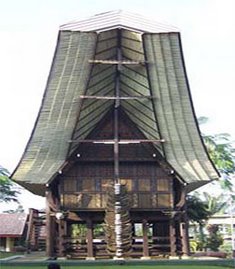
The tongkonan is the traditional Torajan house. It is an ancestral house standing high on wooden piles, covered on top with layered split bamboo roofs curving in sweeping arcs, incised with red, black, and yellow detailed wood carving ornaments at the exterior wall. The word "tongkonan" comes from the Toraja language's tongkon ("to sit").
Tongkonan is the center of Toraja social life. The rituals associated with tongkonan are important expressions of Toraja spiritual life, and therefore all family members are impelled to participate, because symbolically tongkonan represents links to their ancestors and to living and future kin.[15] According to Torajan myth, the first tongkonan was built in heaven on four poles, with a roof made of Indian cloth. When the first Torajan ancestor descended to earth, he imitated the house and held a large ceremony.[20]
The construction of a tongkonan is laborious work and is usually done with the help of the extended family. There are three types of tongkonan. The tongkonan layuk is the house of the highest authority, used as the "center of government". The tongkonan pekamberan belongs to the family members who have some authority in local traditions. Ordinary family members reside in the tongkonan batu. The exclusivity to the nobility of the tongkonan is diminishing as many Torajan commoners find lucrative employment in other parts of Indonesia. As they send back money to their families, they enable the construction of larger tongkonan.

Wood carvings
The Toraja language is only spoken; no writing system exists.[21] To express social and religious concepts, Torajans carve wood, calling it Pa'ssura (or "the writing"). Wood carvings are therefore Toraja's cultural manifestation.
Each carving receives a special name and common motifs are animals and plants that symbolize of some goodwill. For example, water plants and animals, such as crabs, tadpoles and water weeds, are commonly found to symbolize fertility. The left image shows an example of Toraja wood carving, consisting of 15 square panels. The center bottom panel represents buffalo or wealth, because they wish a lot of buffalos for their family. The center panel represents a knot and a box. It is a hope that all of their offspring will be happy and live in harmony, just like goods that are kept safe in a box. The top left and top right squares represent an aquatic animal, indicating the need for fast and hard work just like moving in the surface of water. It also represents the need for a certain skill to produce good results.
Regularity and order are common features in Toraja wood carving (see table below), as well as abstracts and geometrical designs. Nature is frequently used as the basis of Toraja's ornaments, because nature is full of abstractions and geometries with regularities and ordering.[21] Toraja's ornaments have been studied in ethnomathematics to reveal its mathematical structure, but Torajans make these arts only based on some approximations.[21] To create an ornament, bamboo sticks are used as a geometrical tool.

Funeral rites
A stone-carved burial site. Tau tau (effigies of the deceased) were put in the cave, facing down the land.
In Toraja society, the funeral ritual is the most elaborate and expensive event. The richer and more powerful an individual, the more expensive his or her funeral. In the aluk religion, only nobles have the right to have an extensive death feast.[23] The death feast of a nobleman is usually attended by thousands and lasts for several days. A ceremonial site, called rante, is usually prepared in a large area of grass field where shelters for audiences, rice barns, and other ceremonial funeral structures are specially made by the deceased family. Flute music, funeral chants, songs and poems, crying and wailing are traditional Toraja expression for grief with the exceptions of funerals for young children, and poor, low-status adults.[24]
The ceremony is often held weeks, months, or years after the death so that the deceased family can raise the significant funds needed to cover funeral expenses.[25] Torajans traditionally believe that death is not a sudden, abrupt event, but a gradual process toward Puya (the land of souls, or afterlife). During the waiting period, the body of the deceased is wrapped in several layers of cloth and kept under the tongkonan. The soul of the deceased is thought to linger around the village until the funeral ceremony is completed, after which it begins its journey to Puya.[26]


Another component of the ritual is the slaughter of water buffalo. The more powerful the person who died, the more buffalo are slaughtered at the death feast. Buffalo carcasses, including their heads, are usually lined on a field waiting for their owner, who is in the "sleeping stage". Torajans believe that the deceased will need the buffalo to make the journey, and that they will be quicker to arrive at Puya if they have many buffalo. Slaughtering tens of water buffalo and hundred of pigs using a machete becomes the peak of the elaborate death feast, along with dance, music and young boys who catch spurting blood in long bamboo tubes. Some of the slaughtered animals are given by guests as "gifts", which are carefully noted because they will be considered debts of the deceased family.[27]
There are three methods of burial: the coffin may be laid in a cave, in a carved stone grave, or hung on a cliff. It contains any possessions that the deceased will need in the afterlife. The wealthy are often buried in a stone grave carved out of the rocky cliff. The grave is usually expensive and takes a few months to complete. In some areas, a stone cave may be found that is large enough to accommodate a whole family. A wood-carved effigy, called tau tau, is usually placed in the cave facing down over the land.[28] The coffin of a deceased baby or child may be hung from ropes on a cliff face or from a tree. This hanging grave usually lasts for years, until the ropes rot and the coffin falls to the ground.

Dance and music
Torajans perform dances on several occasions, most often during their elaborate funeral ceremonies. They dance to express their grief, and to honour and even cheer the deceased person because he is going to have a long journey in the afterlife. First, a group of men form a circle and sing a monotonous chant throughout the night to honour the deceased (a ritual called Ma'badong),[27][6] and it is considered by many Torajans as the most important component of the funeral ceremony.[24] On the second funeral day, the Ma'randing warrior dance is performed to praise the courage of the deceased during life. Several men perform the dance with a sword, a large shield made from buffalo skin, a helmet with a buffalo horn, and other ornamentation. The Ma'randing dance precedes a procession in which the deceased is carried from a rice barn to the rante, the site of the funeral ceremony. During the funeral, elder women perform the Ma'katia dance while singing a poetic song and wearing a long feathered costume. The Ma'akatia dance is performed to remind the audience of the generosity and loyalty of the deceased person. After the bloody ceremony of buffalo and pig slaughter, a group of boys and girls clap their hands while performing a cheerful dance called Ma'dondan.
As in other agricultural societies, Torajans dance and sing during harvest time. The Ma'bugi dance celebrates the thanksgiving event, and the Ma'gandangi dance is performed while Torajans are pounding rice.[29] There are several war dances, such as the Manimbong dance performed by men, followed by the Ma'dandan dance performed by women. The aluk religion governs when and how Torajans dance. A dance called Ma'bua can be performed only once every 12 years. Ma'bua is a major Toraja ceremony in which priests wear a buffalo head and dance around a sacred tree.
A traditional musical instrument of the Toraja is a bamboo-made flute called Pa'suling (suling is an Indonesian word for flute). This six-holed flute (not unique to Toraja) is played at many dances, such as the thanksgiving dance Ma'bondensan, where the flute accompanies a group of shirtless, dancing men with long fingernails. Toraja has endemic musical instruments, such as the Pa'pelle (made from palm leaves) and the Pa'karombi (the Toraja version of a Jew's harp). The Pa'pelle is played during harvest time and at house inauguration ceremonies.[30]
Language
The ethnic Toraja language is dominant in Tana Toraja with the main language is the Sa'dan Toraja. Although the national Indonesian language is the official language and is spoken in the community,[1] all elementary schools in Tana Toraja teach Toraja language.
Language varieties of Toraja, including Kalumpang, Mamasa, Tae' , Talondo' , Toala' , and Toraja-Sa'dan, belong to the Malayo-Polynesian language from the Austronesian family.[31] At the outset, the isolated geographical nature of Tana Toraja formed many dialects between the Toraja languages themselves. After the formal administration of Tana Toraja, some Toraja dialects have been influenced by other languages through the transmigration program, introduced since the colonialism period, and it has been a major factor in the lingusitic variety of Toraja languages.[6]
A prominent attribute of Toraja language is the notion of grief. The importance of death ceremony in Toraja culture has characterized their languages to express intricate degrees of grief and mourning.[24] The Toraja language contains many terms referring sadness, longing, depression, and mental pain. It is a catharsis to give a clear notion about psychological and physical effect of loss, and sometimes to lessen the pain of grief itself
.
Economy
Prior to Suharto's "New Order" administration, the Torajan economy was based on agriculture, with cultivated wet rice in terraced fjords on mountain slopes, and supplemental cassava and maize crops. Much time and energy were devoted to raising water buffalo, pigs, and chickens, primarily for ceremonial sacrifices and consumption.[11] The only agricultural industry in Toraja was a Japanese coffee factory, Kopi Toraja.
With the commencement of the New Order in 1965, Indonesia's economy developed and opened to foreign investment. Multinational oil and mining companies opened new operations in Indonesia. Torajans, particularly younger ones, relocated to work for the foreign companies: to Kalimantan for timber and oil, to Papua for mining, and to the cities of Sulawesi and Java. The out-migration of Torajans was steady until 1985.[7]
The Torajan economy gradually shifted to tourism beginning in 1984. Between 1984 and 1997, many Torajans obtained their incomes from tourism, by working in hotels as tour guides or selling souvenirs. With the rise of political and economic instability in Indonesia in the late 1990s—including religious conflicts elsewhere on Sulawesi—tourism in Tana Toraja has declined dramatically.

Commercialization

A Torajan tomb in a high rocky cliff is one of the tourist attractions in Tana Toraja.
Before the 1970s, Toraja was almost unknown to Western tourism. In 1971, about 50 Europeans visited Tana Toraja. In 1972, at least 400 visitors attended the funeral ritual of Puang of Sangalla, the highest-ranking nobleman in Tana Toraja and the last pure-blood Toraja noble. The event was documented by National Geographic and broadcast in several European countries.[7] In 1976, about 12,000 tourists visited the regency and in 1981, Torajan sculpture was exhibited in major North American museums.[32] "The land of the heavenly kings of Tana Toraja", as written in the exhibition brochure, embraced the outside world.
In 1984, the Indonesian Ministry of Tourism declared Tana Toraja Regency the prima donna of South Sulawesi. Tana Toraja was heralded as "the second stop after Bali".[5] Tourism was increasing dramatically: by 1985, a total number of 150,000 foreigners had visited the Regency (in addition to 80,000 domestic tourists),[4] and the annual number of foreign visitors was recorded 40,000 in 1989.[7] Souvenir stands appeared in Rantepao, the cultural center of Toraja, roads were sealed at the most visited tourist sites, new hotels and tourist-oriented restaurants were opened, and an airstrip was opened in the Regency in 1981.[15]
Tourism developers have marketed Tana Toraja as an exotic adventure—an area rich in culture and off the beaten track. Western tourists expected to see stone-age villages and pagan funerals. Toraja is for tourists who have gone as far as Bali and are willing to see more of wild, "untouched" islands. However, they were more likely to see a Torajan wearing a hat and denim, living in a Christian society.[7] Tourists felt that the tongkonan and other Torajan rituals had been preconceived to make profits, and complained that the destination was too commercialized. This has resulted in several clashes between Torajans and tourism developers, whom Torajans see as outsiders.[4]
A clash between local Torajan leaders with the South Sulawesi provincial government (as a tourist developer) surfaced in 1985. The government designated 18 Toraja villages and burial sites as traditional tourist objects. Consequently zoning restrictions were applied for these areas, such that Torajans themselves were barred from changing their tongkonans and burial sites. The plan was opposed by some Toraja leaders, as they felt that their rituals and traditions were being determined by outsiders. As a result, in 1987, the Toraja village Kété Kesú and several other designated "tourist objects" closed their doors to tourists. This closure lasted only a few days, as the villagers found it too difficult to survive without the income from selling souvenirs.[4]
Tourism has also transformed Toraja society. Originally, there was a ritual which allowed commoners to marry nobles (puang) and thereby gain nobility for their children. However, tourist imageries have made Torajans concealing their social status. High status is not as esteemed in Tana Toraja as it once was. Many low-ranking citizens can declare themselves and their children nobles by gaining enough wealth through work outside the region, and then marrying a noble woman.[5]

References
1. From Wikipedia, the free encyclopedia

Minggu, 27 Mei 2007

Sumba

Sumba is an island in Indonesia, and is one of the Lesser Sunda Islands. It has an area of 11,153 km², and the population has been estimated as between 350,000 and 425,000. There is a dry season from May to November and a rainy season from December to April. Historically, this island exported sandalwood.
To the northwest of Sumba is Sumbawa, to the northeast, across the Sumba Strait (Selat Sumba), is Flores, to the east, across the Savu Sea, is Timor, and to the south, across part of the Indian Ocean, is Australia. It is in the province of East Nusa Tenggara. The largest town on the island is Waingapu, with a population of about 10,700.
Before colonization, Sumba was inhabited by several small ethnolinguistic groups, some of which may have had tributary relations to the Majapahit Empire. In 1522 the first ships from Europe arrived, and by 1866 Sumba belonged to the Dutch East Indies, although the island did not come under real Dutch administration until the twentieth century.
The Sumbanese people speak a variety of closely related Austronesian languages, and have a mixture of Malay and Melanesian ancestry. Twenty-five to thirty percent of the population practises the animist Marapu religion. The remainder are Christian, a majority being Dutch Calvinist, but a substantial minority being Roman Catholic. A small number of Sunni Muslims can be found along the coastal areas.

References
1. From Wikipedia, the free encyclopedia

External links
• (Indonesian) Anahumba portal
• Sumba deciduous forests (World Wildlife Fund)
• Sumba Foundation
• Textiles of Sumba
• Detailed map

Jumat, 25 Mei 2007

Sumatra

Sumatra (also spelled Sumatera) is the sixth largest island in the world (approximately 470,000 km²) and is the largest island entirely in Indonesia (two larger islands, Borneo and New Guinea, are partially in Indonesia).
History
An ancient name for Sumatra was Swarna Dwipa, (Sanskrit for Isle of Gold), apparently based on the fact that mines in the Sumatran highlands were exporting gold from fairly early times.
With its location in the India-China sea trade route, several trading towns flourished, especially in the eastern coast, and were influenced by Indian religions. The most notable of these were the Srivijaya and the Samudra. Srivijaya was a Buddhist monarchy centered in what is now Palembang. Dominating the region through trade and conquest throughout the 7th–9th century, the kingdom helped spread the Malay culture throughout Sumatra, Malay Peninsula, and western Borneo. The empire was thalassocratic, a maritime power that extended its influence from island to island.
Srivijaya influence waned in the 11th century. The island was then subject to conquests from Javanese kingdoms, first Singhasari and subsequently Majapahit. At the same time, Islam made its way to Sumatra, spreading through contacts with Arabs and Indian traders.
By the late 13th century, the monarch of Samudra kingdom (now in Aceh) had converted to Islam. Ibn Battuta, who visited the kingdom during his journey, pronounced the kingdom "Sumatra", hence the name of the island. Samudra was succeeded by the powerful Aceh Sultanate, which survived to the 20th century. With the coming of the Dutch, the many Sumatran princely states gradually fell under their control. Aceh, in the north, was the major obstacle, as the Dutch were involved in the long and costly Aceh War (1870-1905).
On December 26, 2004, the western coast and islands of Sumatra, particularly Aceh province, were devastated by a nearly 15 meter high tsunami following the 9.2-magnitude Indian Ocean earthquake. The death toll surpassed 170,000 in Indonesia alone, primarily in Aceh.
In 2005 there was an 8.7 magnitude aftershock of the previous earthquake in December 2004. See 2005 Sumatran Earthquake. In addition to the subduction megathrust earthquake off the west coast, Sunda arc, the Great Sumatran Fault, a transform fault, runs the entire length of the island. The pressure on this fault increased dramatically after the December 2004 earthquake, and seismologists are afraid an earthquake is going to occur soon. The fault ends directly below the devastated city of Banda Aceh.
Administration


Political map of Sumatra (old map because Riau Islands Province is not yet shown)
The administrative regions of Sumatra (or the smaller islands nearby) are:
• Aceh - capital: Banda Aceh
• Bangka-Belitung - capital: Pangkalpinang
• Bengkulu - capital: Bengkulu
• Jambi - capital: Jambi
• Lampung - capital: Bandar Lampung
• Riau - capital: Pekanbaru
• Riau Islands - capital: Tanjung Pinang
• West Sumatra (Sumatera Barat) - capital: Padang
• South Sumatra (Sumatera Selatan) - capital: Palembang
• North Sumatra (Sumatera Utara) - capital: Medan

Geography

Geographic map of Sumatra
The longest axis of the island runs approximately northwest - southeast, crossing the equator near the center. The interior of the island is dominated by two geographical regions: the Barisan Mountains in the west and swampy plains in the east.
To the southeast is Java, separated by the Sunda Strait. To the north is the Malay Peninsula, separated by the Straits of Malacca. To the east is Borneo, across the Karimata Strait. West of the island is the Indian Ocean.
The backbone of the island is the Barisan mountains chain. The volcanic activity of this region endowed the region with fertile land and beautiful sceneries, for instance around the Lake Toba. It also contains deposits of coal and gold.
To the east, big rivers carry silt from the mountain, forming the vast lowland interspersed by swamps. Even if mostly unsuitable for farming, the area is currently of great economic importance for Indonesia. It produces oil from both above and below the soil—palm oil and petroleum.
Most of Sumatra used to be covered by tropical rainforest, but economic development coupled with corruption and illegal logging has severely threatened its existence. Conservation areas have not been spared from destruction, either.
The island is the world's 8th highest island, although only the third highest in the Indonesian archipelago.
See also: Islands of Indonesia and Riau islands

Flora and fauna

Rafflesia arnoldii
The island is home to a host of species including: Sumatran Pine, Rafflesia arnoldii (world's largest individual flower), Titan arum (world's tallest and largest inflorescence flower), Sumatran Tiger, Sumatran Orangutan, Sumatran Rhinoceros, Sumatran Elephant, Sumatran Striped Rabbit, Malayan Tapir, Malayan Sun Bear, Bornean Clouded Leopard, and many birds and butterflies.
The major threats to Sumatran forest are the pulp and paper industry and expansion of palm oil plantations.
The island includes more than 10 National Parks, including 3 which are listed as the Tropical Rainforest Heritage of Sumatra World Heritage Site—Gunung Leuser National Park, Kerinci Seblat National Park and Bukit Barisan Selatan National Park.
See also: List of national parks of Indonesia
Demographics

Minangkabau women carrying platters of food to a ceremony
Sumatra is not very densely populated, about 96 people per km²—more than 45 million people in total. It is nonetheless the fourth most populous island in the world. The most populous regions includes most of North Sumatra and central highlands in West Sumatra, while the major urban centers are Medan and Palembang.
The people composed of many different ethnic groups, speaking 52 different languages. Most of these groups, however, share many similar traditions and the different tongues are closely related. Malay-speaking people dominate the eastern coast, while people in the southern and central interior speak languages related to Malay, such as the Lampung and Minangkabau people. The highland of northern Sumatra is inhabited by the Bataks, while the northernmost coast is dominated by Acehs. Ethnic Chinese minorities are also present in urban centers.
A majority of people in Sumatra are Muslims (90%). Most central Bataks, meanwhile, are Protestant Christians—a religion introduced by the Dutch. The rest follow Hinduism, Buddhism, Catholicism, and Chinese traditional beliefs.

See also
• Music of Sumatra

References
From Wikipedia, the free encyclopedia
External links
• Sumatra travel guide from Wikitravel
• http://www.nature-conservation.or.id/sumatra/

Sulawesi

Sulawesi
Sulawesi (formerly more commonly known as Celebes, IPA: [ˈsɛlɛbiz] a Portuguese-originated form of the name) is one of the four larger Sunda Islands of Indonesia lying between Kalimantan and Maluku.

Etymology
The Portuguese were the first to refer to Sulawesi as 'Celebes' however the origins of this name are unclear. One suggestion is the Bugis word si-lebih for 'more islands' - a reference to its shape suggesting it was more than one island. The modern name 'Sulawesi' possibly comes from the words sula ('island') and besi ('iron') thought to be reference to the rich Lake Matano iron deposits.

History
The settlement of South Sulawesi by modern humans is dated to c. 1500 BC. Following Bellwood's model of a southward migration of Austronesian-speaking farmers (AN), radiocarbon dates from caves in Maros suggest a date in the mid-second millennium B.C. for the arrival of an AN group from east Borneo speaking a Proto-South Sulawesi language (PSS). Initial settlement was probably around the mouth of the Sa'dan river, on the northwest coast of the peninsula, although the south coast has also been suggested.[1] Subsequent migrations across the mountainous landscape resulted in the geographical isolation of PSS speakers and the evolution of their languages into the eight families of the South Sulawesi language group.[2] If each group can be said to have a homeland, that of the Bugis – today the most numerous group – was around lakes Témpé and Sidénréng in the Walennaé depression. Here for some 2,000 years lived the linguistic group that would become the modern Bugis; the archaic name, which is preserved in the languages of other Indonesian groups, was Ugiq. Despite the fact that today they are closely linked with the Makasar, their closest linguistic neighbors are the Toraja.
Pre-1200 CE Bugis society would have been organized into petty chiefdoms, which would have both warred and, in times of peace, exchanged wives with each other. Personal security would have been negligible, head-hunting an established cultural practice, and crocodiles and malaria a common source of mortality. The political economy would have been a mixture of hunting and gathering and swidden or shifting agriculture. Speculative planting of wet rice would have taken place along the margins of the lakes.
Starting in the 13th century, access to prestige trade goods and to sources of iron started to alter long-standing cultural patterns, and to permit ambitious individuals to build larger political units. It is not known why these two ingredients appeared together; one was perhaps the product of the other. By 1400, a number of nascent agricultural principalities had arisen in the western Cenrana valley, as well as on the south coast and on the east coast near modern Parepare.[3]
The first Europeans to visit the island (which they believed an archipelago due to its contorted shape) were Portuguese sailors in 1525, sent from the Moluccas in search of gold, which the islands had the reputation of producing.[4] From 1669, the Dutch East India Company had a presence at Makassar, and in 1905 the entire island became part of the Dutch state colony of the Netherlands East Indies until Japanese occupation in World War II. Sulawesi was incoporated in the independent 'Republic of Indonesia' during the Indonesian National Revolution from 1945 to 1950.

Geography
Sulawesi is the world's eleventh-largest island, covering an area of 174,600 km². The island is surrounded by Borneo to the west, by the Philippines to the north, by Maluku to the east, and by Flores and Timor to the south. It has a distinctive shape, dominated by four large peninsulas: the Semenanjung Minahassa; the East Peninsula; the South Peninsula; and the South-east Peninsula. The central part of the island is ruggedly mountainous, such that the island's peninsulas have traditionally been remote from each other, with better connections by sea than by road.
The island is subdivided into six provinces: Gorontalo, West Sulawesi, South Sulawesi, Central Sulawesi, Southeast Sulawesi, and North Sulawesi. West Sulawesi is a new province, created in 2004 from part of South Sulawesi. The largest cities on the island are Makassar, on the southwestern coast of the island, and Manado, on the northern tip.

Flora and fauna

Nomorhamphus liemi female in an aquarium; there are at least 19 species of Nomorhamphus, most of which are only found on Sulawesi.
Sulawesi straddles Wallace's Line meaning that it has a mix of both Asian and Austronesian species. However, the majority of Sulawesi's wildlife belongs to the Australasia region. 2,290 km² of the island is devoted to Lore Lindu National Park.
There are 127 known mammalian species in Sulawesi. A large percentage of these mammals, 62% (79 species) are endemic, meaning that they are found nowhere else in Indonesia or the world. The largest native mammal in Sulawesi is the dwarf buffalo, locally known as the anoa. By contrast, because many birds can fly between islands, Sulawesian bird species tend to be found on other nearby islands as well, such as Borneo; only 34% of Sulawesi's birds are found nowhere else. The most important among these last is the maleo, a bird that spends most of its time on the ground. It has undergone an observed very rapid decline.
Sulawesi also has several endemic species of freshwater fish, such as those in the genus Nomorhamphus, a species flock of livebearing freshwater halfbeaks containing at least 19 distinct species, most of which are only found on Sulawesi.[5] [6]

Population
Demographics
The 2000 census population of the provinces of Sulawesi was 14,946,488, about 7.25% of Indonesia's total population.[7] The largest city is Makassar.

Culture
The people of Sulawesi are famous for their dedication to their diverse art abilities, which include pottery, weaving, and dancing. Their pottery was originally made specifically for the purpose of storing rice and water, but when the Dutch arrived, it became useful for commercial exporting and sale, and was noted for its extensive detail. The Sulawesian people also excel at intricate weaving, and repeat the same pattern at least once in every project they do. Although the women are predominantely weavers, both genders dance. The male dance is rigid, mechanical and robotic, while the female's dances are fluid and smooth. They combine these aspects to tell a story.[citation needed]
Religious faiths
Islam is the majority religion in Sulawesi. The conversion of the lowlands of the south western peninsula (South Sulawesi) to Islam occurred in the early 17th century. The kingdom of Luwu in the Gulf of Bone was the first to accept Islam in February 1605; the Makasar kingdom of Goa-Talloq, centered on the modern-day city of Makassar, followed suit in September.[8] However, the Gorontalo and the Mongondow peoples of the northern peninsula largely converted to Islam only in the 19th Century. Most Muslims are Sunnis. Muslims can be found in all parts of Sulawesi.
Though Islam is the religion of the majority of Sulawesi's people, large regions of the island observe other religions as well.
Christians form a substantial minority. According to the demographer Toby Alice Volkman, 17% of Sulawesi's population is Protestant and 2% is Roman Catholic. Christians are concentrated on the tip of the northern peninsula around the city of Manado, which is inhabited by the Minahasa, a predominantly Protestant people, and the northernmost Sangihe and Talaud islands. The famous Toraja people of Tana Toraja in Central Sulawesi have largely converted to Christianity since Indonesia's independence. There are also substantial numbers of Christians around Lake Poso in Central Sulawesi and among the Pamona speaking peoples of Central Sulawesi. There has also been growth in the Christian population of the Banggai Islands and the Eastern Peninsula in Central Sulawesi, traditionally thought of as Muslim areas (which in the past were controlled by Muslim sultanates in Tidore and Ternate). Christians can be found in every major Sulawesi city.
Though most people identify themselves as Muslims or Christians, they often subscribe to local beliefs and deities as well. It is not unusual (and fully accepted) for Muslims and Christians to make offerings to local gods, goddesses, and spirits.
Smaller communities of Buddhists and Hindus are also found on Sulawesi, usually among the Chinese, Balinese and Indian communities.

Religious conflict
Flag of the Sulawesi separatist movement
Sulawesi has been plagued by Muslim-Christian violence in recent years. The most serious violence occurred between 1998 and 2001 on the once peaceful island. Over 1,000 people were killed in violence, riots, and ethnic cleansing that ripped through Central Sulawesi.[9] The violence pitted the island's Muslims against Christians (and vice versa). A peace accord was not agreed to until 2001.
The Malino peace accord did not eradicate the violence. In the following years, tension and systematic attacks persisted.[10] In 2003, 13 Christian villagers were killed in the Poso District by unknown masked gunmen. And in 2005 three Christian schoolgirls were beheaded in Poso by Islamic militants. A message next to one of the heads allegedly read: "A life for a life. A head for a head".[11]
Riots erupted again in September 2006 in Christian dominated areas of Central Sulawesi, as well as other part of Indonesia, after the execution by firing squad of Fabianus Tibo, Dominggus da Silva and Marinus Riwu, three Catholics convicted of leading Christian militias during the violence of the early 2000s. Their supporters claimed that Muslims who participated in the violence received very light sentences and that none were sentenced to death, and that the government used a double standard.[citation needed] The violence appeared to be aimed at government authorities, not Muslims.[citation needed]
References
1. ^ Bulbeck, F.D. 1992. 'A tale of two kingdoms; The historical archaeology of Gowa and Tallok, South Sulawesi, Indonesia.' Ph.D thesis, The Australian National University.
2. ^ http://web.mac.com/ian.caldwell/iWeb/SulSel1/Languages.html
3. ^ Caldwell, I.A. 1988. 'South Sulawesi A.D. 1300–1600; Ten Bugis texts.' Ph.D thesis, The Australian National University; Bougas, W. 1998. 'Bantayan; An early Makassarese kingdom 1200 -1600 AD. Archipel 55: 83-123; Caldwell, I. and W.A. Bougas 2004. 'The early history of Binamu and Bangkala, South Sulawesi.' Bijdragen tot de Taal-, Land- en Volkenkunde 64: 456-510; Druce, S. 2005. 'The lands west of the lake; The history of Ajattappareng, South Sulawesi, AD 1200 to 1600.' Ph.D thesis, The University of Hull.
4. ^ Crawfurd, J. 1856. A descriptive dictionary of the Indian islands and adjacent countries. London: Bradbury & Evans.
5. ^ The Systematic Review of the Fish Genus Nomorhamphus - Louie, Kristina, research paper, Colgate University, Hamilton, New York, 1993
6. ^ Valid Species of the Genus Nomorhamphus (database entry from fishbase.org)
7. ^ Brief Analysis - A. Total Population (from the 2000 Population Census, Indonesia)
8. ^ Noorduyn, J. 1956. 'De Islamisering van Makasar.' Bijdragen tot de Taal-, Land- en Volkenkunde 112: 247-66; Caldwell, I. 1995. 'Power, state and society in pre-Islamic South Sulawesi.' Bijdragen tot de Taal-, Land- en Volkenkunde 151: 394-421
9. ^ http://news.bbc.co.uk/1/hi/help/3681938.stm Equator - Programme 2 - Asia - BBC News, Sunday September 17 2006, requires JavaScript enabled
10. ^ http://news.bbc.co.uk/2/hi/asia-pacific/3812737.stm
11. ^ http://news.bbc.co.uk/2/hi/asia-pacific/6473897.stm; http://news.bbc.co.uk/2/hi/asia-pacific/6127378.stm
12. From Wikipedia, the free encyclopedia
External links
• Sulawesi travel guide from Wikitravel

Kamis, 24 Mei 2007

Surabaya

Surabaya (formerly Soerabaja) is Indonesia's second-largest city, and the capital of the province of East Java. It is located on the northern shore of eastern Java at the mouth of the Mas River and at the side of the Madura Strait.
The city is one of the busiest ports in the country. Its principal exports include sugar, tobacco and coffee. It has a large shipyard, and numerous specialized naval schools.

Etymology
Surabaya is commonly said to derive its name from the words sura or suro (shark) and baya or boyo (crocodile), two creatures which, in a local myth, fight each other in order to gain the title of "the strongest and most powerful animal in the area according to Jayabaya (1200 M) prophecy. This prophecy tells about big fighting between giant white shark and giant white crocodile in seizing the city upstream. Now the two animals are used as the city's logo, the two facing each other while circling the city's monument, the Tugu Pahlawan (Heroes' monument). This folk etymology, though embraced enthusiastically by city leaders, is somewhat dubious. Alternate derivations proliferate: e.g. from the Javanese sura ing baya, meaning "bravely facing danger". Some people consider this Jayabaya prophecy as a big war between Surabaya native people and invaders in 1945, while another story is about two heroes that fought each other in order to be the king of the city. The two heroes were Sura and Baya.

History

In the fifteenth and sixteenth century, Surabaya was a sultanate and a major political and military power in eastern Java. It entered a conflict with, and was later captured by, the more powerful Sultanate of Mataram in 1625 under Sultan Agung. It was one of Mataram's fiercest campaigns, in which they had to conquer Surabaya's allies, Sukadana and Madura and to lay siege to the city before capturing it. With this conquest, Mataram then controlled almost the whole of Java, with the exception of the Sultanate of Banten and the Dutch settlement of Batavia.
The expanding East Indies Companies took the city over from a weakened Mataram in November 1743. Surabaya became a major trading center under the Dutch colonial government, and hosted the largest naval base in the colony.
In 1917 a revolt occurred amongst the soldiers and sailors of Surabaya, led by the Indies Social Democratic Association. The revolt was firmly crushed and the insurgents given harsh sentences.
During World War II Surabaya was captured by the Japanese in 1942, until the Allies bombed it in 1944. After that it was seized by Indonesian nationalists. However, the young nation was soon put into conflict with the Allied-backed Dutch who tried to retake their colony. The Battle of Surabaya was one of the most important battles of the Indonesian revolution. It was started after British Brigadier General Mallaby was killed in a car explosion in October 30, 1945 near Jembatan Merah (the "Red Bridge"). The Allies gave an ultimatum to the Indonesian freedom fighters inside the city to surrender, but this was refused. The ensuing battle took place on 10 November, nowadays celebrated as Heroes' Day (Hari Pahlawan).
The city was then re-occupied by the Dutch in 1947. Because of prolonged international pressure, the Dutch agreed to transfer sovereignty of its colony in August 1949. Surabaya was ultimately incorporated into Indonesia in December 1949 and rebuilt.

The city


As the main seaport and commercial center in the eastern region of Indonesia, Surabaya has become one of the largest cities in Southeast Asia. Today, Surabaya's population is around three million, and the surrounding metropolitan area houses at least 5 million. The areas surrounding Surabaya include Lamongan to the northwest, Gresik to the west, Bangkalan to the northeast, Sidoarjo to the south, and Mojokerto and Jombang to the southwest.
Currently, the Indonesian government is building the Suramadu Bridge between Surabaya and the island of Madura; when completed, it will be the longest bridge in the country. Madura is currently accessible by a ferry service that operates regularly from Surabaya's port, Tanjung Perak (which literally means: "Silver Cape" in Indonesian).
Surabaya is home to the Eastern Armada, one of two in the Indonesian Navy. Its strong maritime heritage is also reflected with the Submarine Monument, a real retired Russian submarine, called Pasopati, that was converted into a museum ship in the city centre.
Flooding is common in many areas of the city during the rainy season, mostly caused by clogged sewers and inept bureaucracy. The fact that Surabaya is located in a river delta and has a flat and relatively low elevation doesn't help the matter either.
Surabaya is the location of the only synagogue in Indonesia, although it is currently inactive.[1] [2]
Surabaya's zoo, opened in 1916, was the first in the world to have successfully bred orangutans in captivity.
Other points of interest include:
• Grand Mosque of Surabaya, the largest mosque in East Java
• Cheng Ho Mosque, the first mosque in Indonesia built with a Chinese style architecture
• Jales Veva Jaya Mahe Monument, a large, admiral-like statue which commemorates the Indonesian Navy
• Mpu Tantular Museum, has a large collection of ancient Javanese artifacts

Transport
The city is served by Juanda International Airport. The Airport is located in Sidoarjo Region, not in Surabaya City.

Demographics
Surabaya is the second most populous city in Indonesia, after Jakarta. The city is highly urbanized, due to the many industries located in the city, and as a result, there is also a large slum area. As the main education centre, Surabaya has been the home for many students from around Indonesia, thus they have created their own community. Also, Surabaya is the main commercial regionally, hence many outsiders live in Surabaya.

Ethnicity
Most of its population are of Javanese descent. Notable minorities include Balinese, Madurese from nearby Madura Island and Chinese Indonesians.

Language
Most citizens speak a unique dialect of Javanese called Surabayan. This dialect is noted for equality and directness in speech. The usage of register is less strict than the Central Javan dialect. The Surabaya dialect is actively promoted in local media, such as in local TV shows, radio and traditional dramas called Loedroek. The Madurese language influences the Surabayan dialect of Javanese spoken in the streets.

Religion
Islam is the main religion in Surabaya. Other religions including Christian, Catholic, Hindu and Buddhism.

Education
Surabaya has several major universities and other institutions with religious or technical specialties. One of them is Airlangga University (Unair), the oldest and largest public university in eastern Java, with eleven departments in a variety of fields, including an especially well-regarded medical school and psychology department
The Institut Teknologi Sepuluh Nopember is one of the country's most selective technology institutions, and is well-known for its robotics, mechanical engineering, and marine engineering programs.
As one of the Indonesian military's major naval ports, Surabaya is the site of the national Naval Military Academy.

Sister relationships
Surabaya has sister relationships with a number of towns worldwide:
• Seattle, U.S., since 1992
• Kochi, Japan
• Mashhad, Iran

References
1. ^ The Synagogue of Surabaya, Indonesia